In this post, we’re starting a new series, the Advent of Cyber, hosted by TryHackMe. This is the fourth year of the Advent of Cyber, where a challenge is released every day leading to Christmas. There will be 25 challenges; we’re McSkidy, an elf trying to save Christmas.
In our fourteenth challenge, Elf McSkidy has to review the web application security. She consults Elf Exploit McRed who discovers there’s a web vulnerability – IDOR. Can Elf McSkidy find the IDOR on the server?
The topics explored in this challenge are web applications and databases. Along with learning about OWASP (Open Web Application Security Project), access control, and IDORs (Insecure Direct Object Reference)
Can Elf McSkidy find the IDOR on the server? Find out below!
In this post, we’re starting a new series, the Advent of Cyber, hosted by TryHackMe. This is the fourth year of the Advent of Cyber, where a challenge is released every day leading to Christmas. There will be 25 challenges; we’re McSkidy, an elf trying to save Christmas.
In our thirteenth challenge, the SOC team notice suspicious network activity after investigating the malware in Day 12 challenge. Santa’s SOC team needs to analyze the network traffic to see any malicious activity happening on the network.
The topics explored in this challenge are packet and packet analysis. The tool used is Wireshark which is an industry-standard tool for network protocol analysis and is used for traffic and packet investigations.
Can Santa’s SOC determine if there’s malicious activity on the network? Find out below!
In this post, we’re starting a new series, the Advent of Cyber, hosted by TryHackMe. This is the fourth year of the Advent of Cyber, where a challenge is released every day leading to Christmas. There will be 25 challenges; we’re McSkidy, an elf trying to save Christmas.
In our twelfth challenge, Forensics McBlue confirmed the malicious document spawned a suspicious binary. Forensics McBlue’s job is to further analyze the binary via Malware Analysis.
The topics explored in this challenge are malware analysis – why it’s important and how it should be done in a safe environment (such as a sandbox). Items to determine if malware is present such as new network connections, registry key modifications, and file manipulations. Finally, there were two tools that were discussed – Detect It Easy (DIE) and CAPA.
Can Forensic McBlue determine if suspicious file is malware? Find out below!
In this post, we’re starting a new series, the Advent of Cyber, hosted by TryHackMe. This is the fourth year of the Advent of Cyber, where a challenge is released every day leading to Christmas. There will be 25 challenges; we’re McSkidy, an elf trying to save Christmas.
In our eleventh challenge, Elf McDave clicked on a document and now there’s a command prompt running code on their computer. As Elf McBlue we create a memory dump and analyze the dump to determine the root cause.
The topics explored in this challenge are memory forensics and why it’s important. We’re also introduced to the volatility tool that can be used to determine processes and programs that were executed before a computer crash.
Can Elf McBlue dump the image to determine the root cause? Find out below!
In this post, we’re starting a new series, the Advent of Cyber, hosted by TryHackMe. This is the fourth year of the Advent of Cyber, where a challenge is released every day leading to Christmas. There will be 25 challenges; we’re McSkidy, an elf trying to save Christmas.
In our seventh challenge, Elf McSkidy accidentally opened an attachment and believed processes/commands were being executed in the background. McSkidy employs Forensic McBlue to determine if his suspicion is confirmed.
The topics explored in this challenge are reviewing a (potential) malware document through CyberChef.
Is McSkidy’s suspicions about the document correct? Find out below!
I read this article on tech boot camps, inspiring me to write this post.
Dreams Deferred
I recently presented at the CAE (Center for Academic Excellence) Forum, “Dreams Deferred: The Cost of Cybersecurity Education,” discussing boot camps/training center programs centered around cybersecurity.
The inspiration for my presentation came as I read articles discussing potential solutions to retain and strengthen the cybersecurity pipeline. But I didn’t see articles discussing the downside and downright predatory practices of some boot camps/training centers with underrepresented groups.
In the past three months, I encountered four African Americans lured into these programs. When I asked what made them want to pursue these boot camps/training centers, they described reading articles and watching the news discussing the cybersecurity workforce shortage. Each person believed that completing the boot camp/training center program would improve their lives by getting a job in cybersecurity.
(Almost) Dream Deferred
Their stories sparked memories of almost enrolling in a training center after high school. At that time, IT was a hot topic. I remember commercials describing students as “job ready” after completing the program, and IT experience was not required. I felt ahead of the curve as I had IT experience working at a non-profit during high school.
The plan was to go to class in the morning (8am-12pm) as classes were half-days (another selling point) and then go to work afterward. After describing this to my mentor, she advised me to not go down that path. Her words, “Jasmine go to community college, do not destroy your life. If something is too good to be true, most times it is.”
I’m glad my mentor gave that advice. If she didn’t, I wouldn’t have done the amazing things in my career, such as being an intern for the first African American to receive a Doctorate in Computer Science (Dr. Clarence “Skip” Ellis), graduating with my Master’s in Computer Science and Graduate Certificate in Information Security and Privacy, traveling the world presenting cybersecurity topics, and mentoring the next generation of cybersecurity professionals.
Insidious and Predatory Practices
To better understand the insidious and predatory practices of boot camps/training centers, we need to discuss their patterns:
1. Create targeted ads and marketing to underrepresented groups
2. Lure the potential student to get into tech with little to no experience on an accelerated schedule of six months to one year
3. Make the program seem “exclusive” to rush the student to enroll as soon as possible
4. Have students sign private loans to pay for tuition, which on average is between 3k-15k and interest rates of 10%+
5. The coursework is too difficult for the student to master, and they drop out of the program.
OR
6. The coursework is too easy and doesn’t challenge the student
7. The student graduates from the program, doesn’t find a job and has thousands of dollars in debt.
Falling Prey
One of the four people that contacted me described this exact scenario. This person has a private loan for $12,000 with an interest rate of 13%. Their program is six months. I remember telling this person that my interest rate was never that high with all my years of education (Master’s). They also told me they were falling behind in their coursework as the curriculum had drastically increased. When I inquired more about the coursework, I found the curriculum is not accredited, and most of it is currently available on YouTube. After showing them this information, the person felt dejected. Their words, “I spent $12,000 to improve my life, and I could’ve done this on YouTube for free.”
Quality Cybersecurity Education for All
With the increased push to increase and strengthen the cybersecurity pipeline, mainly from the White House with the National Cybersecurity Workforce and Education Summit, the education potential cybersecurity professionals consume must be quality. This is extremely important for underrepresented populations more susceptible to enrolling in faulty programs described above.
I created my non-profit, T-ATP, to provide an environment for prospective cybersecurity professionals to receive quality cybersecurity training and education. Our mission – creating quality cybersecurity education accessible to all. Students shouldn’t go into debt to improve their lives through quality education.
To learn more or support T-ATP, visit the link here.
What’s different between version 1.1.2 to version 2. Well… keep reading
In version 2 I added more dynamic analysis tools such as MARA, PIDCat, QARK. In the pentesting section, I added Metasploit. I also added MobSF (a one stop shop with dynamic scanning for android applications) in a docker container. In version 1.1.2 I tried to upgrade my python version to 3.7.5 and broke my Linux build (could not update the distro).
After speaking with Anant (owner/creator of @AndroidTamer) we decided to put MobSF into a docker container to keep it contained and not break our build.
I also created the virtual machine from a vagrant machine, as I realized with version 1, I severely underestimated the storage I needed to include all the programs I wanted. I also included insecure android apps to test in the Documents folder.
Interested in learning more – download/use the virtual machine at the following location:
As the title suggests, I am working on the second version of the virtual machine I created in 2019.
I put myself out there and decided to create a training on Mobile Security and Bug Bounties – something I wanted to learn and am still interested in.
I noticed there was a virtual machine titled – Android Tamer, score! Well… not really. At the time, Android Tamer was SUPER out of date. Speaking with the creator, Anant Shrivastava about my dilemma needing a virtual machine for my training. Anant told me that it would be easier to create my own virtual machine as opposed to fixing the current version of Android Tamer.
Creating my own virtual machine? I’ve never done that before. Challenge accepted!
Anant, was SUPER helpful with all of my questions and guided me on creating the virtual machine. In about a month the first version was created. Yay!
After the training, I asked for feedback and decided I needed to revamp the virtual machine to make it more accessible/user friendly.
I added and updated out of date software in the virtual machine.
Then I noticed – I was running out of memory when trying to do my upgrades.
I realized at that moment, I totally underestimated the size of the virtual machine.
So, at this time I am revamping the virtual machine and starting with a barebone version of Ubuntu 18.04 (this is the OS the first version was built on) from Vagrant. Again, Anant gave me this advice when creating the first version. I didn’t go down that path as I never heard of Vagrant.
Speaking of Vagrant – shameless plug – I created a course through Cybrary on Intro to Vagrant. The course can be found here.
I started on the quest to version 2 yesterday (Sunday February 7, 2021), and I must say it was trying, yet fun.
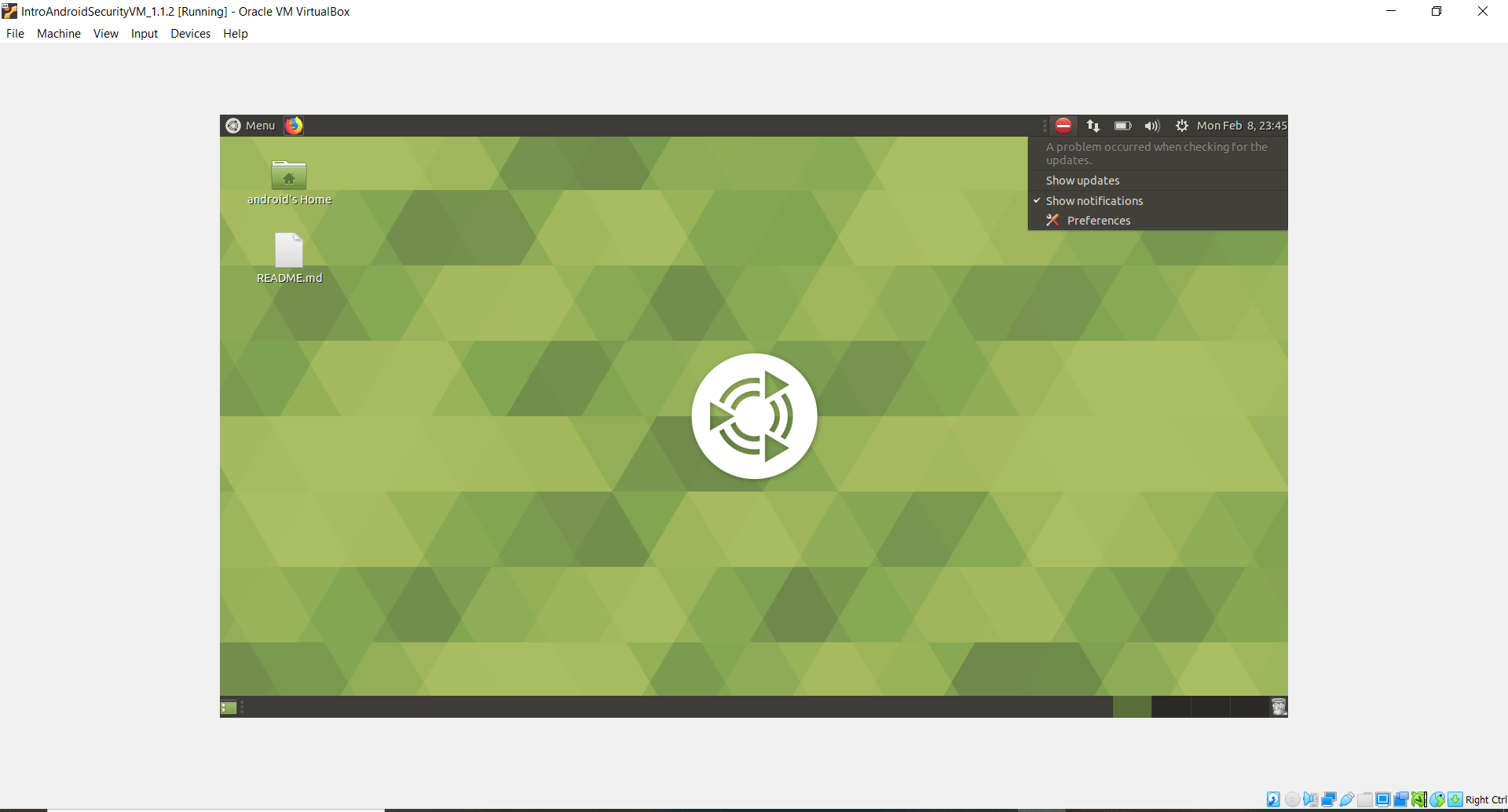
Once I created the vagrantfile and started the vagrant box I realized I was dealing with the command prompt. I knew this wasn’t going to work and I needed to add a user interface. Looking on the internet, I found the lightdm and tried installing it. Once I rebooted my virtual machine, I encountered the error “could not log into session.” The login did not work.
Putting my research hat, I found the following link on how to remediate the no session login. Hmm, the ligthdm is using an older version of the unity framework that needs to be removed.
Rebooting the machine – it was a…
Somewhat success.
I had a user interface, but I didn’t like it. See tweets below
: Here's a screenshot of the VM. I want to have the same look and feel as Ubuntu 18.04. Need to do more research. I'll probably create a blog when I'm done. #MobileSecuritypic.twitter.com/90ihMytwCt
I wanted the user interface to have the same feel as the 18.04 Bionic Beaver operating system.
Doing even more research I found that 18.04 Bionic Beaver is using the MATE desktop.
Back to Google I go. I found a great site on how to install MATE onto a Linux operating system.
Somewhat score? The user interface is getting close, but not there.
: Progress!!! Research showed 18.04 Bionic Beaver was using MATE desktop. So scrapped my original VM, created a new one in #Vagrant and installed MATE desktop. Here's the update… pic.twitter.com/Cnzzl6KoH5
Going back to the site above, I noticed that I installed the wrong version of the MATE desktop. I installed just the MATE desktop without the bells and whistles.
Looking at the bottom for the Ubuntu section it states – “
Alternatively you may choose to install Ubuntu MATE Remix.
Ubuntu MATE is a more comprehensive option that offers a slightly tweaked layout, configuration, and themes to integrate into Ubuntu in a more seamless fashion. This will install the complete MATE Desktop Environment as well as LightDM and numerous other applications to provide a full and well rounded desktop.“
Once I installed the Remixed version – I finally found success!
Now that I have the interface I wanted – it’s time to add the tools and insecure apps.
Yes, that’s what set my virtual machine apart – I have insecure android apps installed in the virtual machine for students to learn mobile and android hacking as well as the common programs needed to perform mobile and android hacking.
On Friday February 5, 2021, I provided a training on teaching Application Security concepts using the OWASP Top 10.
The Open Web Application Security Project or OWASP is a non-profit organization whose mission is to make application security better. Members of OWASP meet every few years to create a top 10 list of the prevalent vulnerabilities in the industry. The last list was from 2017.
The structure of my training is the first part is to present the theoretical part – concepts and definitions. The last part of the training is a practical or application of the first part of the training (theoretical).
For the practical piece I used the website – BodgeIt Store. The BodgeIt Store is an insecure app, that should NOT be deployed in commercial servers. Many will say that the BodgeIt Store is a SUPER old insecure app (it’s close to 10 years old).
The app is close to 10 years old, but I find this app is good to teach application security as there’s a scoreboard and 12 challenges to complete.
Anyway, without further ado below are my slides from my training
I also provided documents that provide a walkthrough of the BodgeIt store as well as installing and using an interception proxy such as Burp Suite.
Finally, I included instructions on how to import the OWASP Broken Authentication VM which have a series of insecure apps.



You must be logged in to post a comment.